Weather & Emergency · LifeStraw Personal Water Filter
Drink without fear.
When water goes wrong — a boil notice after the storm, a flooded well, a tap in a country your stomach doesn’t know — every glass becomes a calculation. This ends the calculation: 4,000 liters of microbiologically safe drinking through a straw that lives in a drawer and weighs less than a phone.
Opens Amazon in a new tab. We never show a price here — the live one is always on the listing.
The bespoke arithmetic
The 4,000-liter ledger.
One straw. Four thousand liters. Do the arithmetic once and the water question goes quiet for years. Drag the slider to what your household actually drinks in a day — the number that comes back is how many days one straw covers.
One straw, measured in days
See today's price →
Days at the maker’s 4,000-liter rating. One straw = one person — the honest plan is one each, and at these numbers each one is years of margin.
| You drink | One straw covers |
|---|---|
| 4 liters a day (drinking only) | ≈ 1,000 days |
| 8 liters a day | ≈ 500 days |
| 16 liters a day | ≈ 250 days |
At the maker’s 4,000-liter rating. One straw = one person — the honest plan is one each, and each one outlasts any realistic outage by years.
The buying moment
The storm passes.
The water question doesn’t.
Bought calm, used desperate. Nobody orders this object excited — they are closing a hole they already know about. The hole has a shape, and it looks like the week after.
Day one
The wind is gone, the lights flicker back, and the city posts the notice: boil before drinking. It stays up for days. Notices outlast storms.
Day two
The ice runs out. The bottled-water aisle emptied before landfall, and restocking takes longer than the news cycle does.
Day three
The tap runs and nobody trusts it. Every glass becomes a calculation: boil, wait, cool, repeat — or find another way.
“I purchased this because I was traveling in parts of the world where you have to buy water because water coming from the tap is not drinkable. It really came in for me in the clutch when I arrived late at night and couldn’t purchase water, but I was dying of thirst. Taste of the plastic isn’t that great but at least I didn’t get sick from using the water from the tap.”
An airport for her. A Tuesday for you.
Hers was travel, not a hurricane. The moment is the same shape: late, everything closed, nothing left to buy, and still thirsty. A boil notice, a flooded well, a tap you don’t know yet — that is the class of moment this object exists for. The plastic taste she mentions is real, and we keep it on the page on purpose. Notice what it is: the whole complaint, from a woman who drank the tap and didn’t get sick.
The tape
125,346 ratings,
flowing past.
Verbatim excerpts from the verified reviews we harvested — ellipses mark omitted words, nothing reworded. The 4-star voice is here on purpose: it is the most useful one on the page.
The evidence
What the membrane does —
and what it never will.
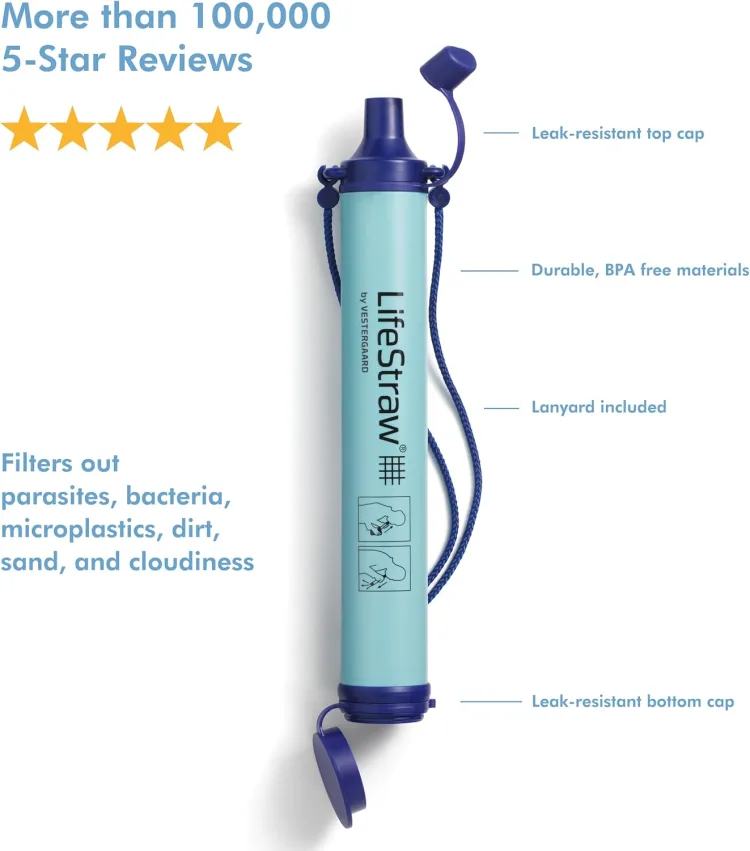
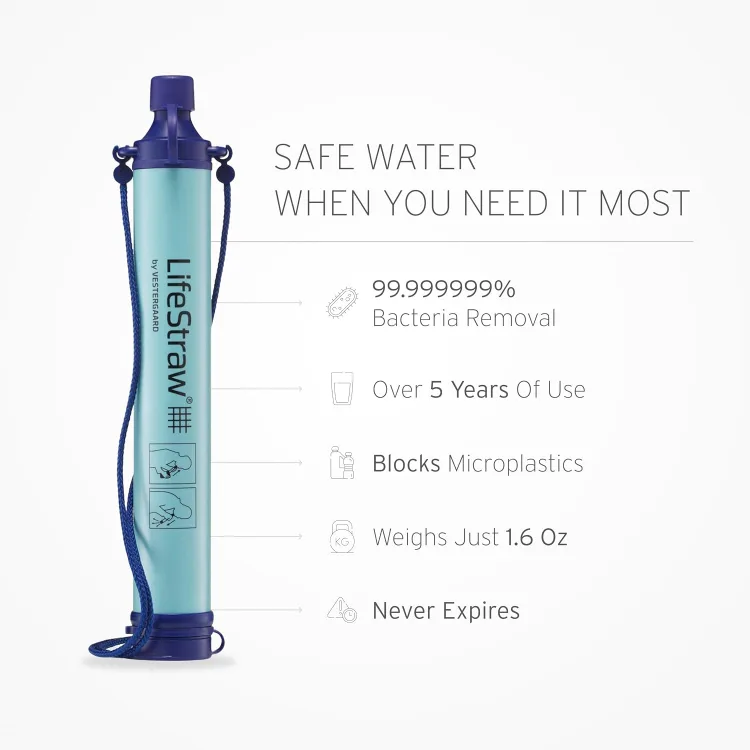
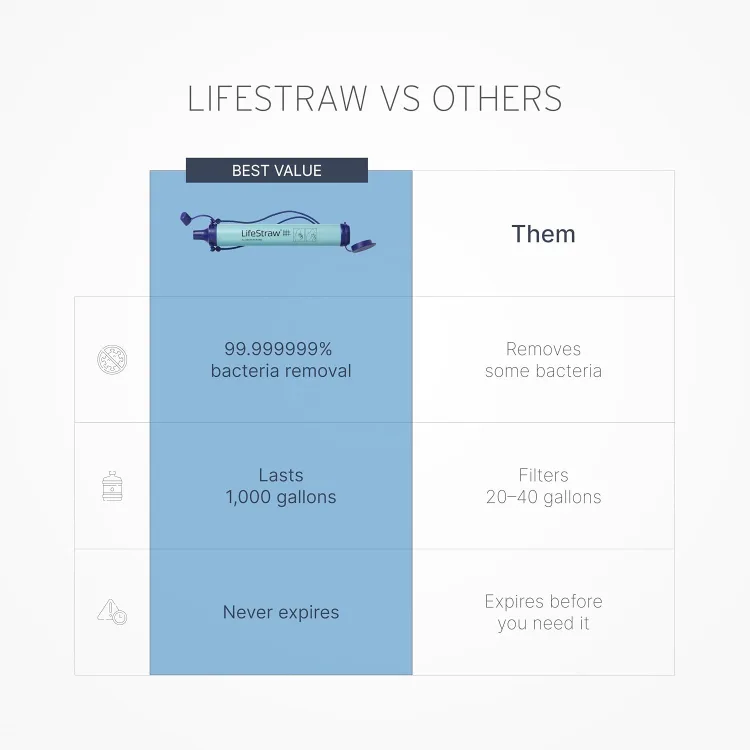
The listing graphics below are the maker’s own, kept in a supporting role. The numbers on them are the membrane’s rated job — stated here as the maker’s claims, because that is what they are.
The maker states these claims are verified by laboratories using US EPA, NSF, and ASTM testing protocols — its wording, kept attributed.
One honest physical note: suction takes real effort for the first draws. That is the class, not a defect — we say it here so the first sip doesn’t surprise you.
Through the membrane
Bacteria — including E. coli and Salmonella. Parasites — including Giardia and Cryptosporidium. Microplastics down to 1 micron. The silt and cloudiness of a questionable source.
Not through it — ever
Viruses. Dissolved chemicals. Heavy metals. Salt. It cannot make seawater drinkable, and it cannot make a chemical spill safe.
Floodwater near industrial runoff is not its job. If your risk is chemical or viral, this is the wrong tool — and we would rather tell you here than sell you the wrong object. For a boil notice, a flooded well, a trail source, or a tap your stomach doesn’t know: bacteria and parasites are the actual threat, and that threat it ends.
The honest comparison
Three other ways
of not drinking it.
No brand names — just the classes you are actually choosing between, and where each one honestly stands.
The stockpile
A bottled-water stockpile
Finite, heavy, and usually gone by day three of a real disruption. It also has to be bought before the shelves empty — which is before you think of it, every single time.
The straw: 4,000 liters in a pocket, on no schedule but yours.
The kettle
Boiling
Boiling works — full stop, and for the pasta pot it remains the answer. But it wants power or fuel plus minutes per liter, in the exact hours when both are scarcest.
The straw: nothing but the water. No flame, no wait, no fuel math.
The pitcher
Pitcher-style filters
A different job, done well: making suspect-tasting tap water pleasant. That is a taste product, not a microbiological one — a pitcher is not rated for the week this page is about.
The straw: built for the microbiological question, rated in writing.
Where this class loses, said plainly: a straw serves one person sipping. It does not fill pots, it is not plumbing, and it does not make chemically-contaminated water safe. For pots, pans, and the rest of the week after, the outage guide carries that kit.
Asked cold, answered straight
The questions everyone
asks before the drawer.
Does the LifeStraw filter viruses or salt water?
No. The LifeStraw membrane removes bacteria, parasites, and microplastics — it does not remove viruses, dissolved chemicals, heavy metals, or salt, and it cannot make seawater drinkable. For most North American backcountry water and for boil-notice tap water, bacteria and parasites are the actual threat, and there it excels. Floodwater near industrial runoff is not its job.
How long does a LifeStraw actually last?
LifeStraw rates the membrane at 4,000 liters — 1,000 gallons — of safe drinking water. For one person drinking a few liters a day, that is years of coverage, which is why a single straw outlasts any realistic outage. The end of the rating announces itself: when you can no longer draw water through it, the membrane is done. Stored dry between uses, it waits in a drawer indefinitely.
Can children use a LifeStraw?
Yes — there are no chemicals, batteries, or moving parts, so a child who can sip through a thick straw can use a LifeStraw. The honest caveat is effort: suction takes real work for the first draws, so a small child may need an adult to start the flow. And the one-straw-one-person rule holds for kids — each child gets their own.
What does water taste like through a LifeStraw?
The water itself comes through clean and neutral, and most owners describe the taste as good. The honest counterpoint is TheresaK's verified 4-star review: 'Taste of the plastic isn’t that great but at least I didn’t get sick from using the water from the tap.' The plastic note belongs to the straw body on the first draws, not the filtered water — and her verdict stands: it was there when she needed it.
How do you store a LifeStraw after using it?
Blow the remaining water back out through the mouthpiece after each use — owners note this keeps the filter clean — then uncap both ends and let it dry before putting it away. Stored dry, a LifeStraw keeps indefinitely: there are no batteries to leak and no chemicals to expire. This is an object that waits well.
Does a LifeStraw work for a whole family?
One LifeStraw serves one person at a time — it filters what you sip through it, nothing else. It does not fill pots, and it is not plumbing. The honest family plan is one straw per person; they are small and light enough that one each is realistic, and at the maker's 4,000-liter rating each one outlasts any realistic outage by years.
Buy it calm.
Use it desperate.
Nobody is excited the day they order this. They are closing a hole they already know about — the week after the storm, the late arrival, the tap they don’t trust yet. It costs less than one case of hotel water, waits in a drawer for years, and asks for nothing: no batteries, no chemicals, and — per the maker — no expiry date. LifeStraw states that every product purchased gives a school child in need safe drinking water for a school year; that is the maker’s claim, and we leave it with them. The day you need it, none of this will be on your mind. The water will just be water.
Opens Amazon in a new tab. We never show a price here — the live one is always on the listing.