USELESS UNTIL NEEDED · THE COLD NIGHT, ANSWERED IN FOIL
The body makes heat until it can't.
A car dead on a winter shoulder. A house with no power on the coldest night of the year. A trail that ran an hour past dusk. The QIO CHUANG 4-pack is four sealed packets, each smaller than a phone, each unfolding to 55 x 84 inches of aluminized mylar that the maker rates to reflect up to 90% of radiated body heat back to the person making it.
Four sheets, each individually folded, wrapped, and sealed — waterproof and windproof per the listing · maker-listed for ground cover, shelter, shade, and signal · reflection is not insulation, and this page says so where it matters.
Reader-supported: we may earn a commission from the Amazon links on this page. It never changes what you pay.
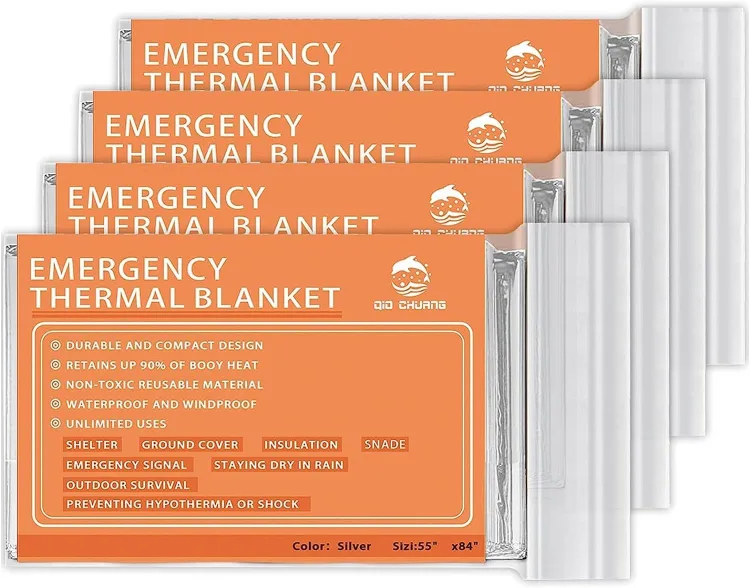
Four sealed packets, one silver edge showing — the whole product, smaller than a phone. The packet print is the maker's own claims list, and this page reads it with attribution, not adjectives.
The heat budget
What a foil sheet does.
What it never will.
Three cold nights, answered in honest physics. Pick the one you are actually buying for — the answer changes less than you'd think, and the plan at the end is the same four packets.
The honest physics
The stranded car
What the foil does there
Wrapped around you, it reflects the heat your body radiates straight back at you — the maker rates the aluminized sheet at up to 90% of it — and it is waterproof and windproof per the listing, so the draft through a dead car and the wet of a hard shoulder stop taxing what your body is still making.
What it does not do
It is not insulation, and it makes no heat of its own. It slows the loss; it does not reverse it. And it does nothing about the heat conducted out of you into a freezing seat — sit on the trunk blanket, a floor mat, anything but bare cold vinyl.
The plan
One sealed packet per vehicle, glove-box flat. Neliza P (5 stars) keeps them because “it’s always good to have in your vehicle no matter what,” and Vero (5 stars) keeps several in every car, in case of.
One per car, one per bag — see today's price Check availability →
1 · The stranded car
Does: reflects radiated body heat back — the maker rates it up to 90% — and blocks wind and wet. Does not: it is not insulation and makes no heat; against a freezing seat you lose heat by conduction, so sit on something. The plan: one sealed packet per vehicle.
2 · The powerless house
Does: the same reflection indoors, layered over the house's own bedding, and it blocks the damp. Does not: it is not a furnace and creates nothing; a powerless house gets cold by every path at once, and the sheet only closes the radiation path — loudly. The plan: one per go-bag, one in the home kit.
3 · Caught out past dusk
Does: wraps cloak-style, sheds wind and wet snow, and hands your own heat back while you walk out. Does not: it will not make a light jacket a winter one; if you stop, cold ground drains heat by contact — sit on your pack, not the ground. The plan: one per hiking belt, purse, or pack.
The size story
Pocket-size to person-size
in seconds.
The whole trick of this object is the fold. What leaves the packet is seven feet of sheet; what stays in your glove box is smaller than the phone in your pocket.
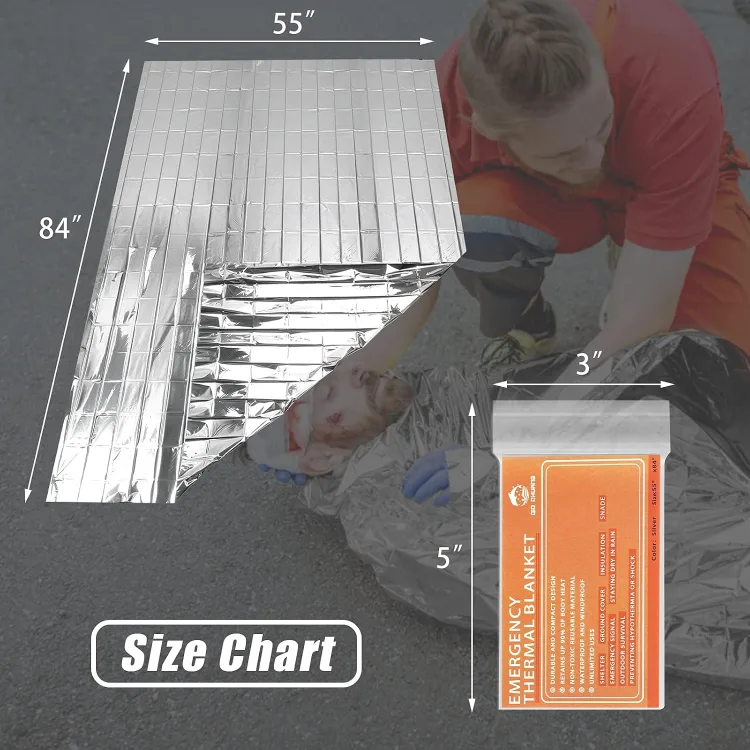
The pocket-to-person math
The maker's own size chart: 55 x 84 inches of sheet beside the 3 x 5 inch packet it folds from. That is the entire product idea in one picture — it costs almost nothing to carry, and it becomes almost a person-sized shelter skin when it has to.
The four-pack is not four blankets. It is four places.
One in each car's glove box. One in the go-bag. One in the home kit, next to the flashlight. The reviewers who rely on these stopped thinking of them as camping gear years ago — they think of them as the thing that is already there.
“It’s always good to have in your vehicle no matter what.”
Neliza P — the every-vehicle plan, five stars
“They are in every pack-out first aid kit I've sent out in the last few years.”
Shelley K. — the kit-builder, five stars
Stock the four places — see today's price Check availability →
The voices
8,462 ratings.
Eight voices, passing through.
Verbatim excerpts from the live listing, names and stars as printed — Brandon's four stars shown as four. And Vero's headline — “They stink, but good product” — is the one this page refuses to soften: the mylar smell is real, and she still keeps several in every car and cuts them to line feral-cat houses in winter.
The evidence
The class of moments,
then the fine print.
The maker's usage grid shows the moments this object exists for. Beside it, the part most pages skip: every claim attributed, and every limit stated in plain words.
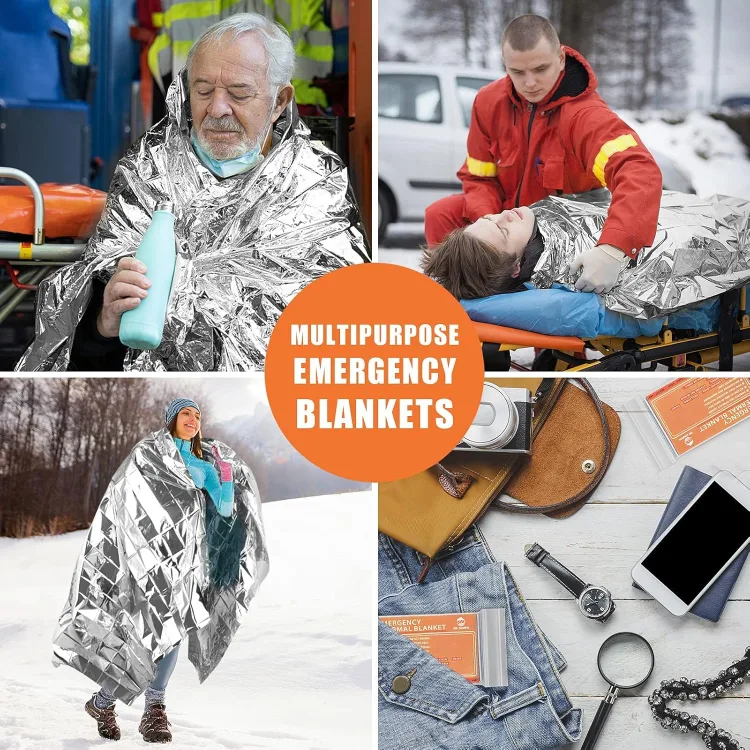
The class of moments
Ambulance-side, stretcher, snow line, kit flat-lay — the maker's own usage grid, printed as evidence of the class of moment this is for, not as staged promises. Nobody in these pictures planned their night.
The honesty block — five things, unsold
This is the part a product page usually buries. Here it is the feature.
- “Up to 90%” is the maker's radiant-reflection rating — attributed to the maker, not measured by us. Reflection is not insulation, and nothing in the packet creates heat.
- Conduction is the cold killer the sheet does not solve. On frozen ground you need something under you — Shelley K.'s field answer is two sheets, one as “a barrier for the ground,” one over you.
- Treat each sheet as once-deployed. The maker says reusable; realistically, refolding to the 3 x 5 inch packet is a one-way trip. The pack holds four for a reason.
- It crinkles loudly, all night. Casey (5 stars), post-op: “rather noisy & feels like you’re a rotisserie chicken with the texture.”
- The mylar smell is real. Vero's five-star headline, intact: “They stink, but good product.” Rough handling also punctures it — Brandon (4 stars) handles his with care around sharp objects, and Amazon's own summary notes durability draws mixed feedback.
The honest comparison
What it beats.
What beats it.
Three classes get cross-shopped against a foil sheet. Here is where this one objectively stands apart — and then, said plainly, where this class loses.
The trunk blanket
vs a real blanket in the trunk
A fabric blanket is bulkier, absorbs wet, and still lets your radiated heat leave. The mylar sheet is windproof, waterproof, and pocket-sized. The honest play is not either-or: the blanket fights the conduction through the seat, the sheet closes the radiation path. Carry both.
The sleeping bag
vs a sleeping bag
The sleeping bag wins every planned night — it is loft, comfort, and real insulation, and it should. The foil sheet wins the night nobody planned: the one where the sleeping bag is at home in a closet because this was supposed to be a two-hour drive.
The hand warmers
vs hand warmers
Warmers add a little heat, mostly to hands, for a few hours. The sheet keeps the heat your whole body is already making. Different physics, genuinely complementary — the warmers spend, the sheet saves.
Where this class loses — said before you buy
- It punctures and tears with rough handling. This is a thin mylar film, not a tarp. Brandon (4 stars) is the honest owner note: tear-resistant for its class, but handle it with care around sharp objects — and Amazon's own review summary says durability draws mixed feedback.
- The refold is a one-way trip. The maker calls it reusable, and as a ground sheet or windbreak it is. But getting it back into its 3 x 5 inch packet is practically impossible — treat each sheet as once-deployed for warmth duty.
- It crinkles loudly, all night. There is no quiet version of this material. Casey slept wrapped in one after surgery and called it “rather noisy” while saying it still worked great for keeping her warm. Believe both halves of that sentence.
The questions, cold
Asked before
the page existed.
They keep the heat you already have — that is the honest version. QIO CHUANG rates the aluminized sheet to reflect up to 90% of your radiated body heat back toward you, which is real physics and a real difference on a cold night. But reflection is not insulation, and the sheet creates no heat of its own. Shelley K. (5 stars) says it straight: they will not keep you warm if you are not dressed for the weather — they will keep you dry in the rain.
Each QIO CHUANG sheet opens to 55 x 84 inches — seven feet of aluminized mylar, enough to wrap an adult cloak-style or line a shelter wall. Folded and sealed, the packet is about 3 x 5 inches: smaller than a phone, flat enough for a glove box, a purse, or a hiking belt. Four sealed packets come in the pack.
The maker says reusable, and the sheet itself can absolutely serve more than once — as a ground cover, a windbreak, a shelter skin. The honest caveat is the refold: getting a deployed QIO CHUANG blanket back into its 3 x 5 inch packet is practically a one-way trip. Treat each sheet as once-deployed for warmth duty. That is why the pack holds four.
Yes — the maker lists ground cover, shelter, shade, and emergency signal among its uses, and the sheet is waterproof and windproof per the listing. Ground duty matters more than it sounds: frozen earth drains heat by contact faster than air does, so one sheet under you and one over you is the field answer. Shelley K. carries them exactly that way — a barrier for the ground.
Both are class truths, not defects. The sheet is a thin film of aluminized mylar, and mylar creases loudly — expect crinkle all night. The smell is real too, and this page will not soften it: Vero's five-star headline reads “They stink, but good product.” She still keeps several in every car and lines feral-cat houses with them in winter.
One per vehicle, minimum — plus one per go-bag and one in the home kit. The reviewers who rely on these run exactly that plan: Neliza P keeps them in the vehicle no matter what, Vero keeps several in every car, and Shelley K. builds them into every pack-out first-aid kit she sends out. Four sealed packets is precisely that distribution, bought once.
The whole thesis
Bought once. Forgotten.
There on the worst night.
Four sealed packets, distributed across the cars and bags of a household, costing almost nothing in space or attention — until a winter shoulder, a dead furnace, or a trail past dusk makes them the most important thing you own. That is this entire catalog in one object: useless until needed, and priceless exactly once.