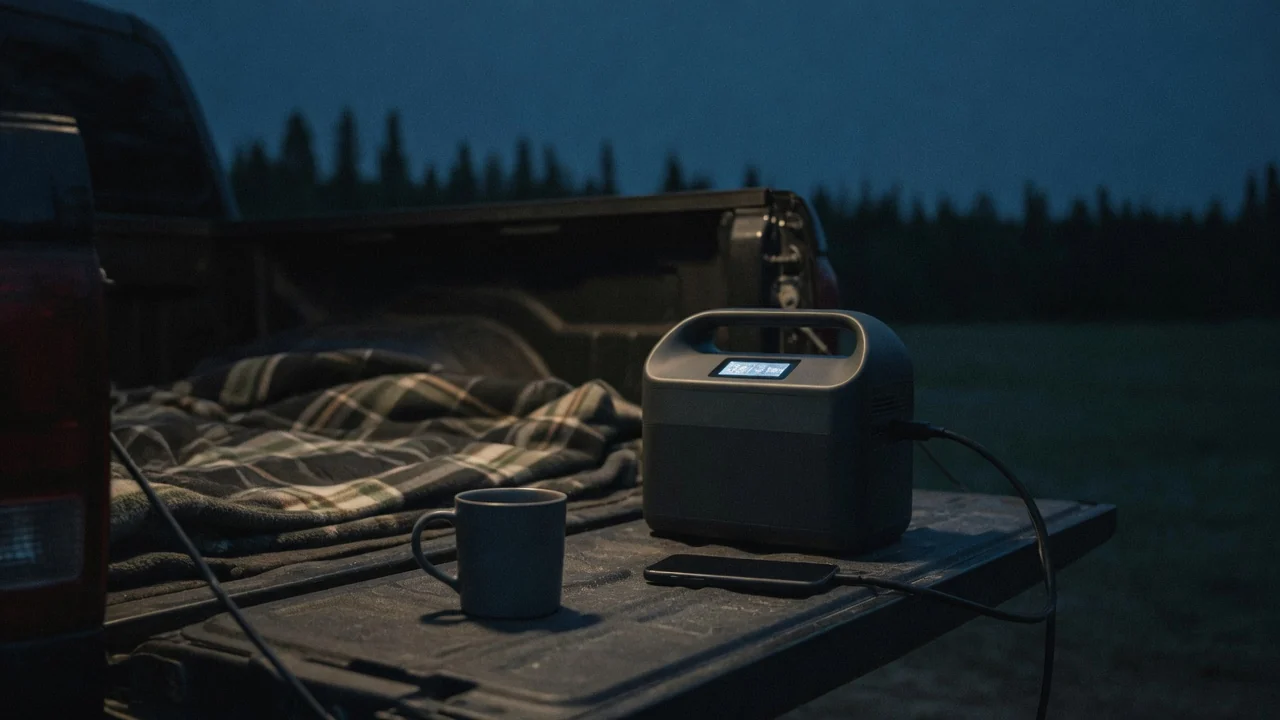

A pickup truck tailgate at night, far from any house: a plaid blanket and a mug in the truck bed, and a small power station with a glowing display beside a charging phone

USELESS UNTIL NEEDED · FIELD REPORT: THE PULL-OFF

Enough power for the things that matter. Honest about the rest.

Somewhere off the highway, past the last streetlight: a tailgate, a blanket, a mug, and a phone at nine percent. The Jackery Explorer 300 is 292 watt-hours that actually gets carried — seven and a half pounds, one handle, silent — because most nights were never about the refrigerator. They are about the phones staying alive, a lamp, the router, maybe a CPAP. Enough, and not more.

4.6 11,131 Amazon ratings

292Wh LiFePO4 · 300W rated output (600W surge) · two AC outlets plus a 100W USB-C PD port · 7.5 lb with an integrated handle · solar panel sold separately

Reader-supported: we may earn a commission from the Amazon links on this page. It never changes what you pay.

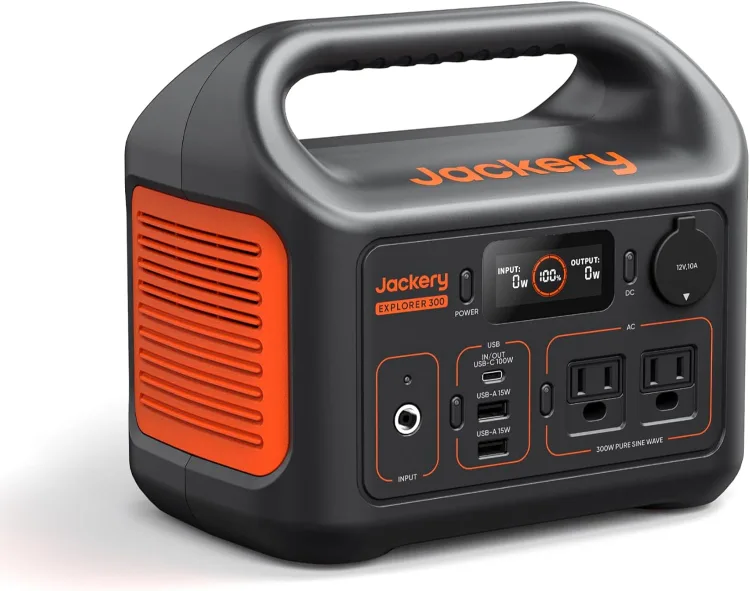
The Jackery Explorer 300 portable power station, maker product shot
Jackery Explorer 300
292Wh · 300W AC · LiFePO4 · 7.5 lb · maker product shot

What 292 watt-hours honestly covers.

Two boxes on this one site, one question: what are you actually protecting? Tap a load and the row lights up with the arithmetic. One of these rows is a plain no — and losing that sale honestly is the entire point of this page.

Explorer 300292Wh · 300W rated · 600W surge — this page
Explorer 1000 v21070Wh · 1500W rated · 3000W surge — the bigger box
Phones a household of them, on repeat
About 14 full recharges
Assuming roughly 20Wh per full phone charge, idealized from the 292Wh label — inverter losses shave it.
About 53 full recharges
The same 20Wh arithmetic on the 1070Wh label. More than most outages ever ask.
Lamp + router light and internet through the dark
About 14 hours
Assuming a 10W LED lamp and a 10W router — 20W combined, idealized. One long work-from-home day.
About 53 hours
The same 20W pair on 1070Wh — light and Wi-Fi for a long weekend.
CPAP the machine that runs all night or nobody does
About 7 hours — one night
Assuming roughly 40W average with the heated humidifier off. A humidifier can nearly double the draw — check your machine's label.
About 26 hours — three nights
The same 40W machine on 1070Wh, humidifier off. Breathing room for a multi-night outage.
Refrigerator the reason most people shop the big one
NO — not for a minute
300W rated, 600W surge: a compressor's startup spike is bigger than that, so the unit trips before a watt of cooling happens. The box for this job is the Explorer 1000 v2.
About 7–10 hours
Assuming a modern fridge averaging 100–150W over its duty cycle — the compressor cycles, so the average is what matters.
The verdict

A refrigerator is a compressor problem, and the Explorer 300 cannot start a compressor — 300W rated, 600W surge, and the startup spike is bigger than that. Not for a minute. If food is what you are protecting, the Explorer 1000 v2 is the honest buy, and we say so on our own site.

The row lighting needs JavaScript — with it off, the full comparison stands as printed. Nothing is hidden.

The small one is enough — see the price

Permission to buy the small one on purpose.

The instinct says the bigger box is the safer buy. The arithmetic says otherwise — and the difference between the two columns is not small. Here is the case for the 7.5-pound answer, made out loud.

The garage-corner test

A heavy power station is a garage appliance: it lives on a shelf next to the paint cans, and on the morning you need it, it is neither charged nor with you. Seven and a half pounds with a handle is a different species — it rides in the trunk, goes in the camp bag, sits on the closet shelf by the flashlight. The best power station is the one that is actually there.

Buy for the loads you have

Outage anxiety says buy the biggest box on the page. The split above says the night you are actually planning for — phones, a lamp, the router, a CPAP — fits inside 292 watt-hours with room to spare. Spending the difference on capacity you will never touch is not preparation. It is just cost.

The generator you never have to buy

A gas generator means fuel, stabilizer, monthly test runs, a pull cord, fumes and noise the whole street hears. This class is silent, indoor-safe and maintenance-free — and it runs a fraction of the load. Both halves of that sentence are the point, and the second half is the section after next.

“I imagined how I’d have to check a generator every month. The maintenance. Wheeling the heavy unit around. Getting & storing fuel … The fumes from running it. The loud noise … All that seems overwhelming for more than 99% of our needs.”

TCTX 1836 · verified purchase · single parent, two teenagers, one Jackery 300

See today's price on Amazon Check availability on Amazon

Four voices from the corpus.

These are the four reviews we hold verbatim — an outage household, a camping-and-boat family, a blackout backup buyer, a single parent with teenagers. The honest mix of uses this product actually gets.

“It saves having a whole house generator like my relatives in other hard hit weather states with outages.”— jarvad. “We went camping recently for a week and it charged two phones all week without needing to be plugged back in.”— D2 “If the power goes out, no stress, we just grab the Jackery. It’s practically silent.”— TCTX 1836 “It is compact, light and very easy to transport … perfect for trips, camps or to have as a backup in case of a blackout.”— Dunia Breijo Oviedo

Seven and a half pounds: car, camp, boat, closet.

Capacity you never carry is capacity you never use. The owners' own words map exactly where this box goes — and it is not the garage corner.

See today's price Maker listing image: a hiker carrying the Jackery Explorer 300 by its top handle on a forest trail, annotated 7.5 pounds ultra-light
Maker's listing image for the carry claim: 7.5 lb with an integrated handle, about 9 × 7.8 × 5.5 inches as the maker annotates it — the portability this page is built on.
The car

Wall charge before you leave, car-port cable in the box for the road. jarvad., who owns two of these, puts it plainly: “Vehicle travel usage designed, too.”

The campsite

D2's family took it out for a week: “We went camping recently for a week and it charged two phones all week without needing to be plugged back in.”

The boat

Same household, second habitat: “We camp a lot and also have a cruising boat. This is a must-have for both environments.” Compact and it holds its charge, per the same review.

The closet

And for the night the grid drops, TCTX 1836: “If the power goes out, no stress, we just grab the Jackery. It’s practically silent and light enough to move around by just about anyone.”

The one you'll actually carry — see the price Check availability

What it will never run.

292Wh and a 300W ceiling is the whole story, and it gets its own section before any more buy buttons. We would rather lose the sale here than have you learn this at 2 a.m.

  • A kitchen refrigerator. The compressor's startup spike is bigger than the 600W surge ceiling — the unit trips before a watt of cooling happens.
  • A window air conditioner. Same compressor problem, plus a running draw that sails past 300W.
  • A space heater, hair dryer, coffee maker or microwave. Resistive heat lives between 600W and 1500W — over the ceiling, full stop.
  • Anything with a compressor, and most things that make heat. If it hums, surges or glows, it is not this box.

If your list has one of those on it, the box you want is the Explorer 1000 v2 — 1070Wh and a 1500W ceiling, the refrigerator class. See the bigger box →

None of those are mine — see the price Check availability

Every number, conditions attached.

Maker photography in supporting roles, with the claim each one carries printed beneath it. The projections and solar figures are the maker's, with the maker's conditions.

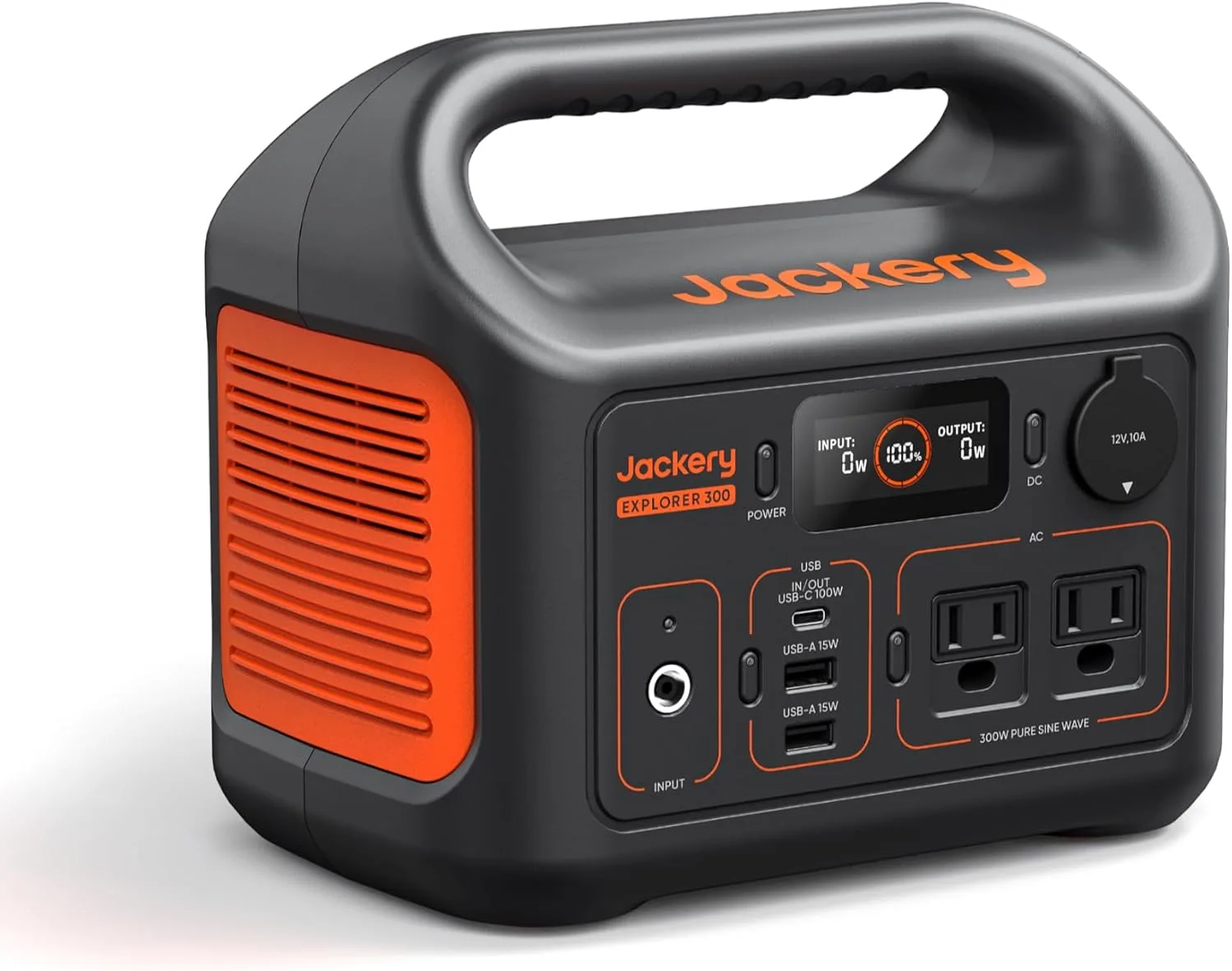
Maker product shot of the Jackery Explorer 300 front panel: two AC outlets, USB-C, two USB-A ports, car port and the charge display
The face of it, per the maker: two AC outlets, a 100W USB-C PD port, two USB-A ports, the 12V car port, and the display that shows input, output and charge remaining. Six devices at once, under a 300W combined ceiling.
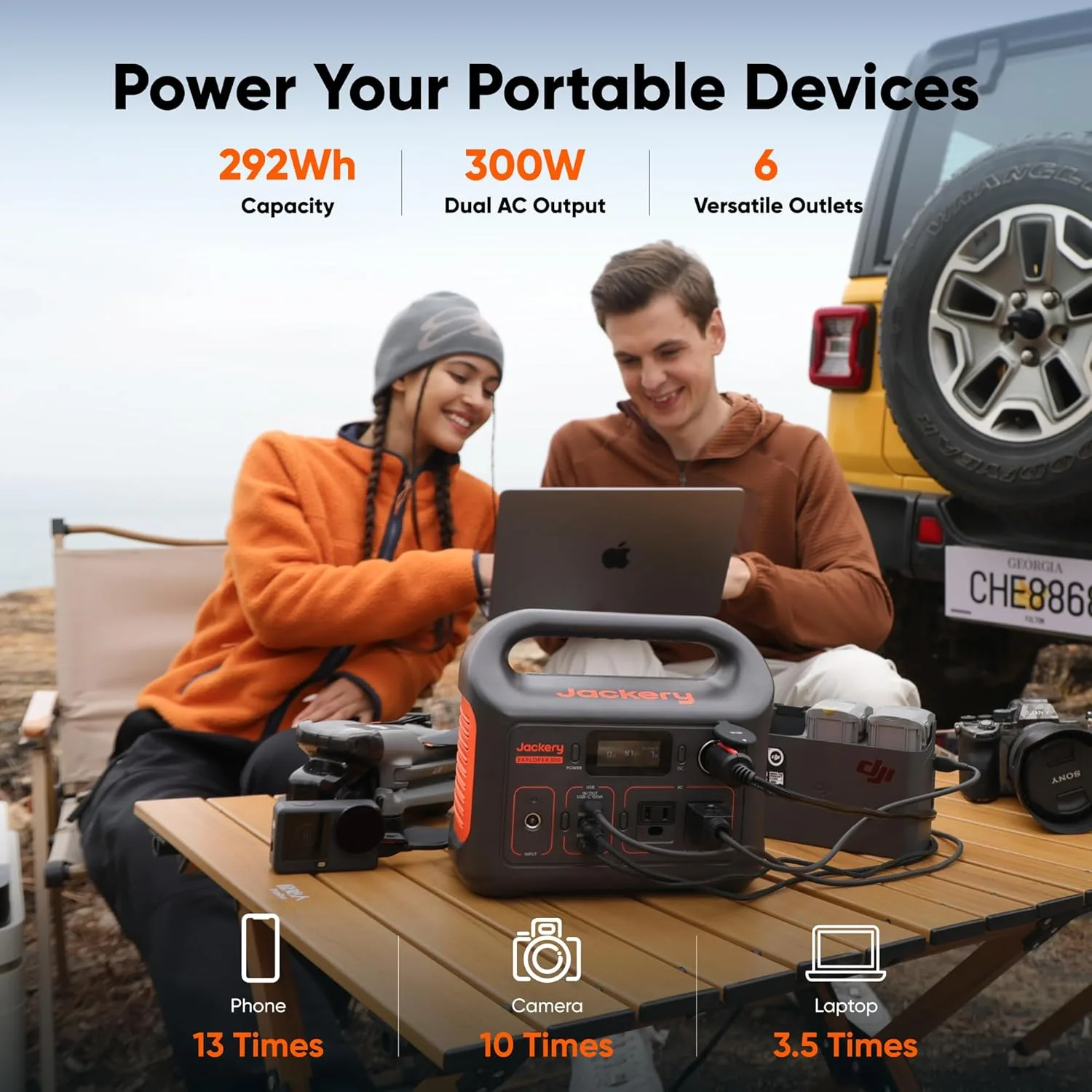
Maker listing graphic for the Jackery Explorer 300 showing 292Wh capacity, 300W dual AC output and recharge estimates for a phone, camera and laptop
The maker's own recharge estimates, printed as the maker prints them: a phone about 13 times, a camera about 10, a laptop about 3.5. Idealized figures — our table above runs the same arithmetic with the assumptions showing.
292Wh
LiFePO4 capacity
300W / 600W
rated output / surge peak
7.5 lb
with integrated handle
6 ports
2 AC · USB-C 100W PD · 2 USB-A · 120W car port
4,000+ cycles
to 70% capacity — maker's LFP projection, not a warranty
~2.8 h to 80%
with a 100W panel, ideal sun, panel sold separately

In the box: the Explorer 300, an AC wall adapter, a car charger cable and a user guide. Not in the box: the solar panel — the “more than 11 years” service framing is the maker's projection from the 4,000-cycle rating, not a warranty.

See today's price on Amazon Check availability

4.6 out of 5, from 11,131 ratings.

Verbatim reviews below, exactly as posted. The corpus is outages and campsites and one cruising boat — we present it as that mix, not as an outage-only product.

4.6 out of 5
11,131 global ratings
5 star82%
4 star9%
3 star4%
2 star1%
1 star4%
Amazon's AI-generated summary of customer reviews
“Customers find the power station charges quickly and works well with solar panels, providing long-lasting power that lasts all night. They appreciate its portability for travel and camping, and its versatility with multiple outlets and simultaneous charging capabilities. Customers like its compact size, with one mentioning it's perfect for powering a portable fridge/freezer cooler.”

That last mention refers to small 12V portable coolers in the camping class — a kitchen refrigerator is still a plain no, for the compressor reasons in the split above. The most-mentioned topics across the corpus:

Charging speed 519 Performance 501 Battery life 405 Portability 395 Versatility 309 Size 281
“Good Charging Backup Power During Outages”
“Portable power station is used for power outages to power cell phone, tablet and electronic devices. It saves having a whole house generator like my relatives in other hard hit weather states with outages. Jackery charges iPad faster under one hour than electric wall outlet with same cable, reducing Jackery to 84%. I like digital display showing stats. I also like buttons turning green during charging. Good ports for usb, two-prong electrical make it easy to use. I own two Jackery Power Stations. Long lasting battery. Zippered pouches for storing connecting cable is good. Vehicle travel usage designed, too.”

jarvad. · April 8, 2026 Verified purchase

14 people found this helpful

“Good product.”
“We camp a lot and also have a cruising boat. This is a must-have for both environments. Compact, seems well made, holds its charge well. The bigger sizes will give you more power, but this is great for charging phones and iPads. We went camping recently for a week and it charged two phones all week without needing to be plugged back in.”

D2 · July 22, 2026 Verified purchase

6 people found this helpful

“Jackery 300 - A Modern Necessity”
“I’m a 100% full time single parent with 2 teens. And with teens you know that means a lot of electronic devices. I need things that work and things that simplify my life. The Jackery 300 has been one of those purchases. It’s not only reliable but really easy to use. Most power outages are not very long lasting. So, I didn’t want to fool with a generator. I imagined how I’d have to check a generator every month. The maintenance. Wheeling the heavy unit around. Getting & storing fuel. Having enough fuel. Making sure the fuel lasts. Struggling to pull start it. The fumes from running it. The loud noise when it actually does run. Not to mention, an easy thousand plus bucks to buy one. All that seems overwhelming for more than 99% of our needs. If the power goes out, no stress, we just grab the Jackery. It’s practically silent and light enough to move around by just about anyone.”

TCTX 1836 · September 11, 2020 Verified purchase

“Excellent portable, practical and reliable power station”
“It has been an excellent investment. It is compact, light and very easy to transport, which makes it perfect for trips, camps or to have as a backup in case of a blackout.”

Dunia Breijo Oviedo · July 4, 2026 Verified purchase

5 people found this helpful

These four are the reviews we hold verbatim, and all four happen to be five-star — the live corpus is wider: 82% five-star, and about 9% at three stars or fewer. We show the histogram as-is rather than cherry-picking a cleaner picture, and we do not invent reviews we did not harvest.

See the reviews on Amazon Read all 11,131 ratings on Amazon

Asked cold, answered straight.

No — not a kitchen refrigerator. The Explorer 300 is rated at 300W with a 600W surge peak, and a refrigerator compressor's startup spike exceeds that before the fridge ever settles into its running draw. Even a running fridge averaging 100–150W would drain 292Wh in about two hours. If protecting food is the job, the larger class is the honest answer — we compare it directly with the Jackery Explorer 1000 v2 on this page. Small 12V camping coolers are a different, much smaller load; owners report running those, but the kitchen fridge is a plain no.

The everyday essentials, with the arithmetic out loud: a phone recharged about 14 times over at roughly 20Wh a charge, a 10W LED lamp plus a 10W internet router for about 14 hours, a laptop a few charges over through the 100W USB-C port, camera and drone batteries, a tablet — up to six devices at once, so long as the combined draw stays under 300W. All figures are idealized from the 292Wh label; real-world inverter losses shave them.

For many machines, yes. Budgeting roughly 40W for a CPAP with the heated humidifier off, 292Wh works out to about seven hours — a night. With a heated humidifier running, draw can climb toward 60W or more, and the same battery is closer to half a night. Check your machine's label; if you need the humidifier, or two nights untended, size up to a larger unit.

No. The box contains the Explorer 300, an AC wall adapter, a car charger cable and a user guide — the solar panel is sold separately. With Jackery's 100W panel under ideal sun the maker quotes 80 percent in about 2.8 hours; a 40W panel stretches that to about 7.5 hours. Both figures carry the maker's conditions.

Jackery publishes no standby-drain figure for the Explorer 300, so we will not invent one. The LiFePO4 chemistry in this class is known for holding charge well on a shelf, one verified owner reports it holds its charge well across a week of camping, and the front display makes a seasonal check a ten-second job. Top it up from the wall before storm season and it is ready.

It depends on what you are protecting — that is the whole point of the honest split on this page. Phones, a lamp, a router and a CPAP fit inside the Explorer 300's 292Wh with room to spare, and buying bigger is money spent on capacity you never touch. A refrigerator, a window air conditioner or anything with a compressor is the Explorer 1000 v2's job: 1070Wh and a 1500W ceiling that can actually start one.

See today's price on Amazon Check availability

Buy the small one on purpose.

If your night is phones, a lamp, the router and a CPAP, the Explorer 300 is enough — and not more. If your night is the refrigerator, you want the bigger box, and this page told you so to your face. Either way, you buy the right one.

Power the essentials — see today's price Check availability

Protecting food instead? The Explorer 1000 v2 is this way →

Opens Amazon in a new tab. We never show a price here — the live one is always on the listing.

Jackery Explorer 300 4.6 · 11,131 ratings
See today's price