USELESS UNTIL NEEDED · FIELD REPORT 006 — AUTOMOTIVE
Cold morning. Low-tire light. No gas station.
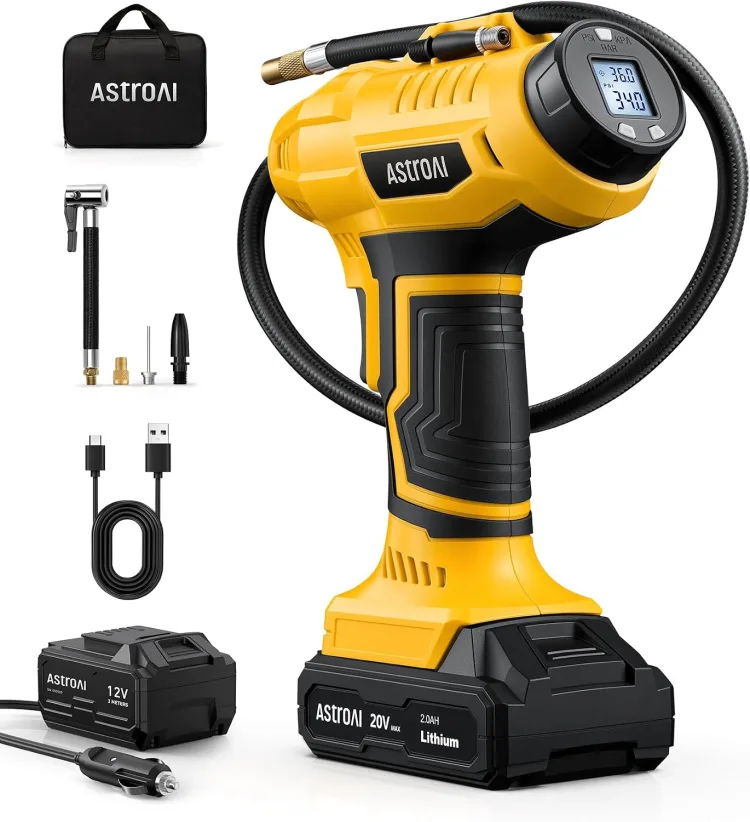
The AstroAI Cordless Tire Inflator turns that errand into two minutes in your own driveway: hose on the valve, your number set on the digital gauge, one press — and it stops itself at the pressure you set. 4.6 stars across 16,548 Amazon ratings, with the honest catches up front: it is noisy, and a charge is a set of tires, not a season.
160 PSI maximum rating — a ceiling, not a target · 20V battery + 12V DC backstop cord · auto shut-off at your preset · digital gauge in PSI / BAR / KPA · up to 4 standard tires per charge (maker's figure) · LED light · storage bag + adapters
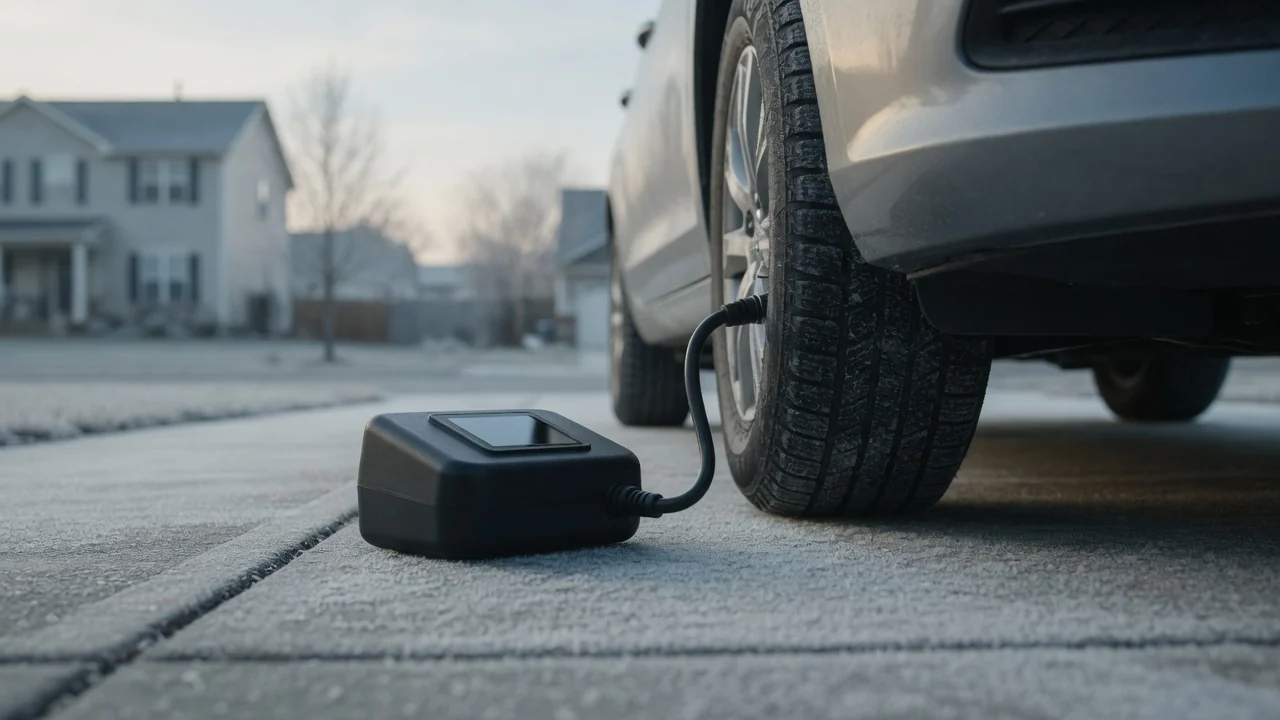
The hero scene is a generated illustration of the cold-driveway morning — the frost, the concrete, the hose on the valve. Every number and every quote below comes from the maker's listing or the 16,548-rating review corpus.
The right number
The number on the tire is a maximum.
The target is on your door.
The single most common mistake this product touches: inflating to the number molded into the tire — a maximum — instead of the number on the driver's door jamb, which is the target. A passenger car typically lives in the low-to-mid 30s PSI, but only the sticker on your door jamb is authoritative for your car. Slide the dial and learn to read it.
The dial — 25 to 45 PSI
- door jamb (your target) — the sticker inside the driver's door; a passenger car typically reads in the low-to-mid 30s
- tire sidewall (a maximum, not a target) — the molded number is the most the tire can hold, not what it should run at
The door-jamb zone.
The low-to-mid 30s is where most passenger cars live — but typical is not authoritative. The sticker inside your driver's door jamb carries the only number that counts for your car. Set the inflator to that number and it stops itself there.
This page teaches where to look, never what your number is — no chart on the internet can read your door jamb for you. The dial's bands describe typical passenger-car territory, nothing more.
Found the zone? The sticker on your door jamb has the final word —See today's price →25 to 29 — under the typical zone
Most passenger-car door jambs call for the low-to-mid 30s. A tire sitting down here is exactly when the dashboard light comes on. If it dropped this far in days rather than months, that is a leak talking, not the weather.
30 to 35 — the door-jamb zone
Where most passenger cars live. But typical is not authoritative: the sticker inside your driver's door jamb carries the only number that counts for your car.
36 to 39 — above the typical zone
Some vehicles legitimately live up here — heavier cars and some SUVs run higher door-jamb numbers. Read the number off your car, not off a chart.
40 to 45 — sidewall-maximum territory
The number molded into the tire's sidewall is a maximum, not a target. Inflating a passenger car to its sidewall is the classic mistake this page exists to un-teach.
The honest edge of the whole dial: a tire that needs air every week needs a repair shop, not a compressor. Topping up masks a leak; it does not fix one. This tool's job is keeping healthy tires at their number — and getting a wounded one safely to the shop.
The driveway routine
Two minutes in slippers.
The errand dies here.
The old options were all bad: a station pump that eats quarters and reads wrong, a corded compressor that needs the engine running, or ignoring the light until the tire is genuinely unsafe. This is the fourth option — and after one cold morning it stops being an emergency tool and becomes the garage tool.
07:02 — THE LIGHT
It picks the cold mornings
Tire pressure falls with the temperature, so the amber symbol appears on the same chilly week every year. The tire usually is not flat — it is just under its number, and the drive to the station pump feels like exactly what it is: an errand.
07:04 — THE NUMBER
Read the door jamb, once
Open the driver's door and read the sticker on the jamb — the target pressure for your car. Ten seconds, one time, and it is the same number every cold snap after. The dial above explains why the tire's own number is not it.
07:05 — THE WALK-AWAY
Set it, press once, walk away
Hose on the valve, number set on the digital gauge, one press. The auto shut-off stops it at your preset — a reviewer describes it exactly: set the psi you want, turn it on and it airs it up and shuts off when at the desired psi.
07:07 — BACK INSIDE
Coffee still hot
No coins, no queue, no guessing whether the station gauge is honest. Two minutes in slippers, in your own driveway, and the low-tire light is out before the kettle is. That is the whole product.
The boundary of the routine: run it on the same tire every week and the problem is not pressure, it is a puncture. A shop fixes leaks. This keeps good tires at their number.
Set the pressure and walk away - see the price Check availability on Amazon →
From the 16,548 reviews
Verbatim excerpts, typos and all — the cautionary ones included. Hover to pause.
"I filled a lawn tractor tire that went flat, then filled two bicycle tires and topped off my car tires. All on one charge with power to spare."
"set the psi you want, turn it on and it airs it up and shuts off when at the desired psi"
"it doesn't pump up tires FAST, but it does do the job well"
"Lightweight but it is noisy."
"I inflated both generator tires to 30 pounds faster than removing both tire valve caps."
"So much more convenient than the pump I was using with electrical cords!"
"Very good and fast air flow! Easy to read display and customer service is AWESOME !"
"This one will get hot and stop working correctly."
Beyond car tires
Then it stops living in the trunk.
The pattern in the reviews is always the same: bought for the emergency, kept for the household. The adapters ride in the bag, and the same set-it-and-walk-away works on everything with a valve.
The bikes
One Saturday, one charge
Evereddie70's review reads like a yard-work victory lap — a flat lawn tractor tire, two bicycle tires, then his car tires, all in one session.
"I filled a lawn tractor tire that went flat, then filled two bicycle tires and topped off my car tires. All on one charge with power to spare."
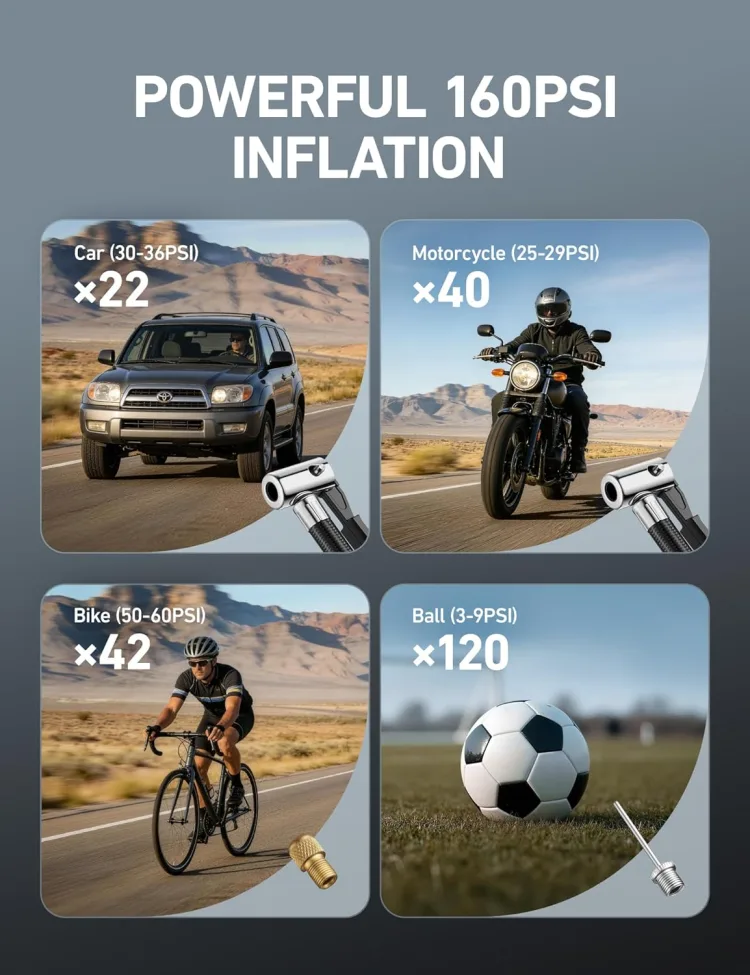
The adapter kit in the bag covers bike valves. The maker's own graphic claims 42 bike-tire top-ups (50-60 PSI) per charge — its figure, its test conditions.
The mower + the tractor
No more dragging the air tank out
The job that graduates this from trunk to garage. The wheelbarrow is the same job with a different wheel.
"This has been so handy to have. I don't have to carry around an air tank when my lawn mower tires get low." — Amazon Customer
Evereddie70 filled a lawn tractor tire that had gone flat — from flat, on the same charge as everything else that day.
The truck at 65 PSI
Above car numbers, it keeps working
Higher-pressure tires just mean longer runs per tire — the preset and the auto shut-off work the same way up the dial.
"We have used it to air up the tires on his truck, 65psi. It works like a charm." — Amazon Customer, on his brother's truck
The class boundary, honestly: a big truck tire as a steady diet wants a bigger compressor. Occasional duty, this handles.
The inflatables
The generator, the balls, the air mattress
The needle and adapter set in the bag covers sports balls and inflatables — the air mattress stops being a floor-pump workout.
"I inflated both generator tires to 30 pounds faster than removing both tire valve caps." — Steven A.
Same preset, same auto-stop — a basketball gets the right pressure, not a guess. The maker's graphic claims 120 balls per charge.
Straight talk
What it tops up, and when you should be at a shop instead
Six limits, said plainly — because a tool you understand is a tool you can trust a cold morning to.
- 160 PSI is a ceiling, not a working pressure. It is the maker's maximum rating — headroom, not a target. A passenger car typically runs in the low-to-mid 30s, set from the door jamb; nobody's door sticker says 160. The big number on the box is not the number for your tire.
- It is noisy. Five-star reviewer Texas Lady, verbatim: Lightweight but it is noisy. Small compressors are loud as a class — that is physics, not a defect. Budget two loud minutes per tire, then silence. A buyer should know before, not after.
- A charge is a set of tires, not a season. The maker says up to 4 standard tires per charge; Robert Maine's 4-star review reports adding pressure to 4 tires in a row with about half to three-quarters of the battery left. Maker and buyer agree — and that agreement is worth more than either alone.
- Back-to-back jobs heat it up. The follow-up reviewer: fine for 2 small tires, but if you have more than one vehicle that needs air, you will do better with an air compressor. This one will get hot and stop working correctly. He also reports the valve-stem attachment leaking until he pinches it. Quoted so you know before, not after.
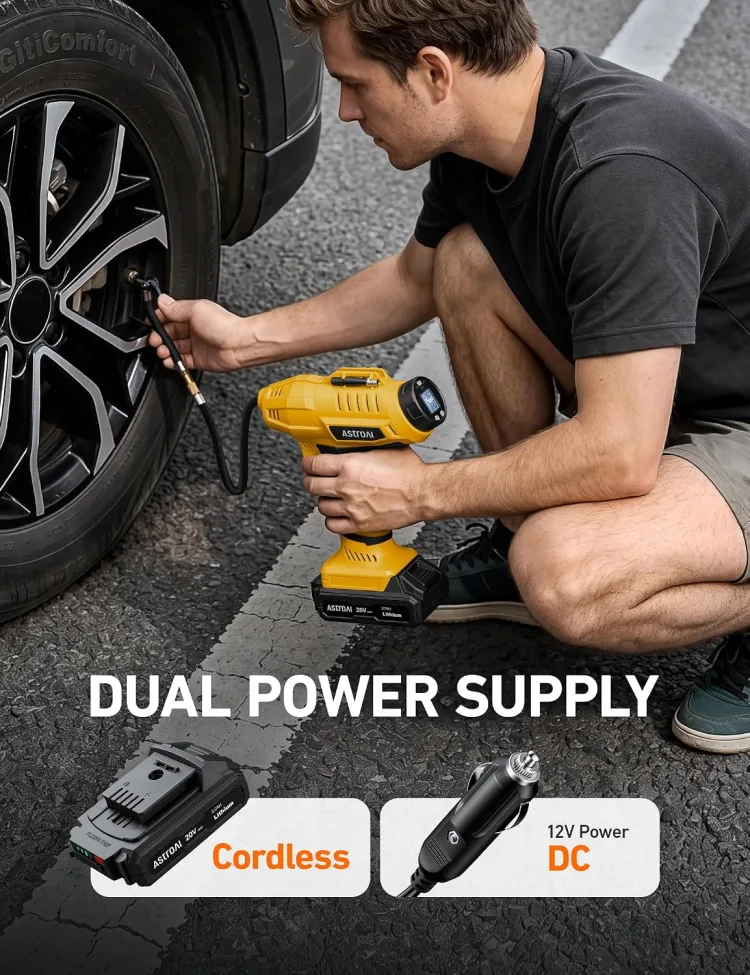
- The 12V cord is the backstop. Battery flat? The 12V DC adapter runs it straight from the car's power outlet. And a box note from the maker, plainly: a USB-C charging cord is included; a wall charger is not.
- A weekly-air tire needs a shop. Topping up masks a leak; it does not fix one. This is a top-up tool for healthy tires — a tire losing air every week has a nail, a valve stem, or a bead problem, and those are shop jobs.
The maker's claims, labeled
The spec sheet, in context.
Everything below is the maker's own imagery with the claims attached. We quote; the 16,548 reviews do the vouching.
Receipts
16,548 ratings.
The errands it already ended.
on the live Amazon listing
"So I was tired of dragging an air compressor around and a bike pump and a plug in car compressor. This replaces them all at a great price. I filled a lawn tractor tire that went flat, then filled two bicycle tires and topped off my car tires. All on one charge with power to spare. … This is easy to use, comfortable to hold, has good power, digital display and easy set points, it works great. It comes with connection accessories, a charger, a car plug-in adaptor if needed and a nice case to keep it all in. I'll keep mine in the car but its good for all around the house."
"After carefully reading the directions, I tried it.....and it WORKS! I added pressure to 4 tires in a row, and it had about 1/2-3/4 of the battery capacity left after that. Now, it doesn't pump up tires FAST, but it does do the job well. You know, in So CA, it's been hard to find any gas station or other spots to refill tires, so this has become a necessity. Good product."
"This has been so handy to have. I don't have to carry around an air tank when my lawn mower tires get low. … We have used it to air up the tires on his truck, 65psi. It works like a charm. Follow up. It's still working fine, on the most part. The attachment used to air up valve stems is leaking and will not add air properly. I can pinch it in the spot, that will allow it to add air effectively. It's good for 2 small tires, but if you have more than one vehicle that needs air, you will do better with an air compressor. This one will get hot and stop working correctly. All that being said, it is still something I have with me just in case I need to top off some air pressure."
"Works great. Easy to use. Compact. Automatically shuts at desired set pressure.Lightweight but it is noisy. I had one before this one and it lasted about 4 years. Worth it to have peace of mind."
"I bought this originally to have in my car for emergencies. But I've started using it in the garage to top off my tire pressures. So much more convenient than the pump I was using with electrical cords! This cordless inflator features a pressure set point so set it and it automatically stops when the set pressure is reached. So easy! Love it!."
"Worth every penny. Extremely easy to use. Quick! I inflated both generator tires to 30 pounds faster than removing both tire valve caps. Comes in a great case love the fact that I can charge a battery or also use the DC adapter."
"Has auto shut off for desired pressure very durable and compact to carry in car a must for low tires ! Very good and fast air flow! Easy to read display and customer service is AWESOME ! Would highly recommend this to anyone that drives!"
Quick answers
Asked before the first cold snap.
The target is printed on the sticker inside your driver's door jamb — not on the tire. The number molded into the sidewall is a maximum, not a target, and inflating to it is the classic mistake. A passenger car typically sits in the low-to-mid 30s PSI, but only your door-jamb sticker is authoritative for your car. The AstroAI Tire Inflator is built for exactly this routine: dial in the jamb number on its digital gauge, and the auto shut-off stops the pump the moment it gets there.
Noisy — and this page says so because a five-star reviewer did. Texas Lady's verdict, verbatim: Lightweight but it is noisy. Small compressors are loud as a class; the AstroAI Tire Inflator is not the exception. Plan on about two loud minutes per tire in the driveway, then silence. If a quiet pump is the dream, the honest answer is that the quiet ones are bigger, corded, and live in garages.
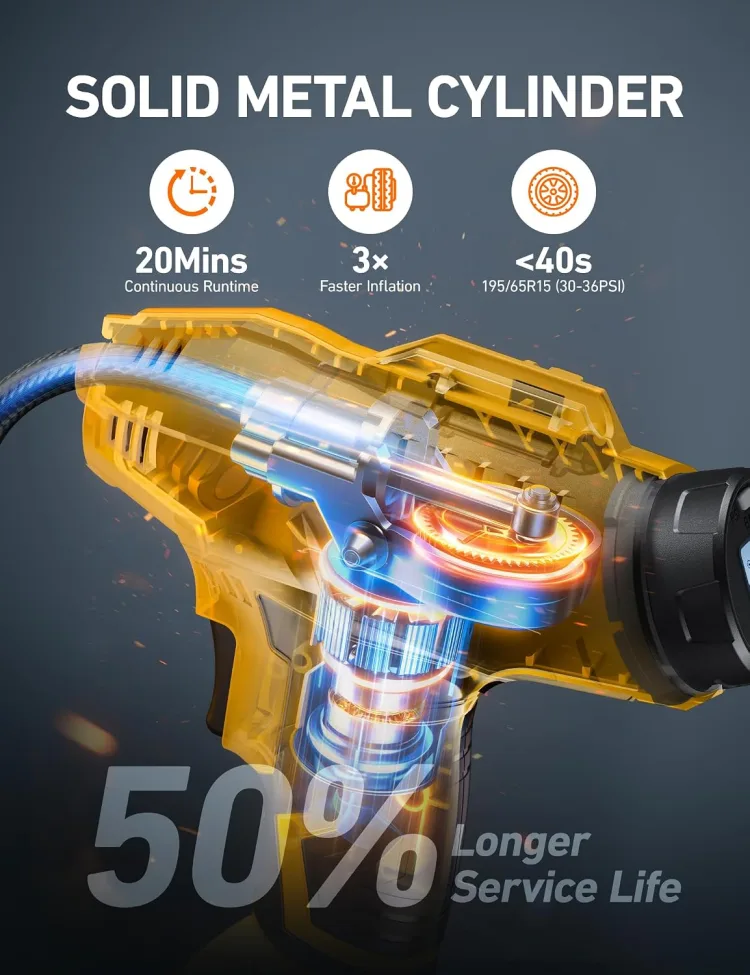
The maker's figure is up to 4 standard vehicle tires on a full charge — and a 4-star reviewer (Robert Maine) reports the same from the buyer side: he added pressure to 4 tires in a row and had about half to three-quarters of the battery left. Maker and buyer agreeing is worth more than either alone, so the honest framing is a set of tires per charge, not a season of them. The maker's own graphic counts 22 car-tire top-ups (30 to 36 PSI) per charge — note that is top-ups, not flat tires.
Yes. Alongside the rechargeable 20V battery, the AstroAI Tire Inflator ships with a 12V DC cord that plugs into the car's power outlet, so a flat battery is an inconvenience, not a stranding. One box note from the maker, said plainly: the package includes a USB-C charging cord but no wall charger.
Yes — the bag includes multiple nozzle adapters for bicycles, sports balls, and inflatables, and reviewers put them to work. One verified buyer filled a flat lawn-tractor tire, two bicycle tires, and topped off his car on a single charge; another inflated both generator tires to 30 pounds faster than removing both tire valve caps. The same preset-and-auto-stop applies to the AstroAI Tire Inflator whatever it is filling, so a basketball gets the right pressure rather than a guess.
No — and this is the boundary the whole page respects. The AstroAI Tire Inflator is a top-up tool: it restores pressure, it repairs nothing. A tire that needs air every week has a leak — a nail, a valve stem, a bead seat — and leaks are shop jobs. Use it to reach the shop on a safe tire, which is exactly what it is for.
The close
The light comes back every year. Be boring about it.
First cold snap, same amber symbol, same two choices: the errand, or two minutes in your own driveway. Order it, charge it the day it arrives, drop it in the trunk with its bag — then forget it until the morning it earns its keep. And for the other kind of morning — the click instead of the engine — its trunk-mate is below.
The trunk-kit pairing: NOCO Boost GB40 The other thing that gets a dead car moving — a 2.5 lb lithium jump starter for the morning the battery, not the tire, is the problem.Set the pressure and walk away - see the price Check availability on Amazon →
Opens Amazon in a new tab. We never show a price here — the live one is always on the listing.